
· Elena Marsh
Can you put boiling water in a glass teapot?
The question comes up because everyone has cracked a drinking glass with hot water at some point. That experience is real, and it is about a different material.
projected annual growth for leaf tea in North America through 2031
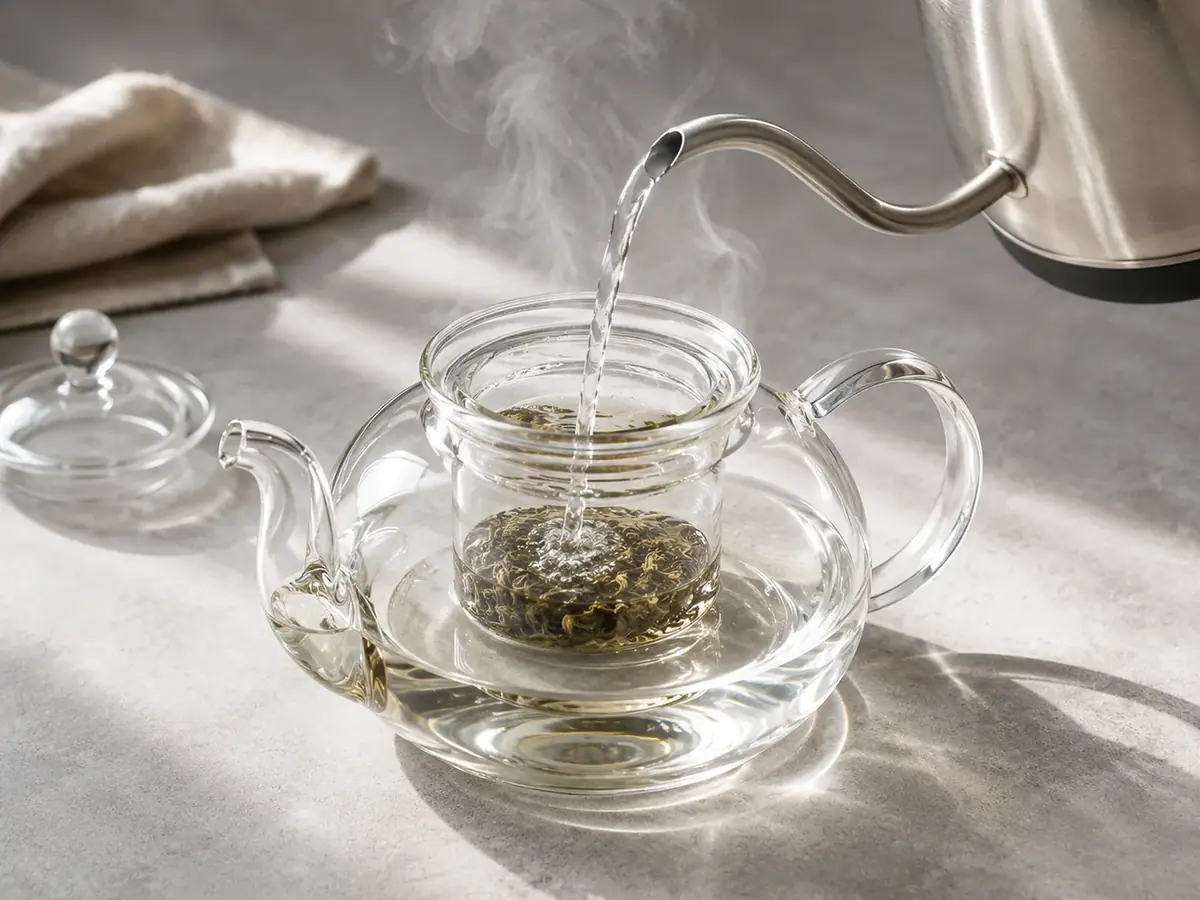
What actually cracks glass
Not heat. Uneven heat.
When you pour boiling water into a cold glass, the inner surface heats and tries to expand while the outer surface is still cold and does not. The two layers pull against each other, and if the stress exceeds what the material can take, it fractures. That is thermal shock, and how much a glass expands per degree is what decides whether it survives.
Borosilicate versus ordinary glass
Adding boron oxide to the melt produces a glass that expands roughly a third as much as soda-lime glass for the same temperature change. Less expansion means less stress between the hot and cold faces, which means a far wider margin.
It is the same reason borosilicate is standard for laboratory glassware, where things get heated directly over flames. A teapot is a much gentler application than a beaker on a burner.
| Borosilicate | Soda-lime | |
|---|---|---|
| Used for | Teapots, lab glass, ovenware | Drinking glasses, jars, windows |
| Thermal expansion | Low | About three times higher |
| Boiling water poured in | Designed for it | Risky when cold |
Our glass teapots are borosilicate, body, lid and infuser insert.
Two habits worth keeping anyway when you pour boiling water into a glass teapot
Pour onto the leaves
Aim the stream at the leaf bed in the insert rather than at bare cold glass. The leaves absorb and spread the heat, so the glass warms more evenly. It also makes better tea, because the whole dose wets at once.
Do not go straight from cold storage to boiling
A pot that has been in a cold cupboard is fine. A pot that has been in the fridge with cold brew in it should come up to room temperature first. This is about the size of the temperature jump, not about a weakness in the material.
Preheating, which helps for a different reason
Swirl a little hot water in the empty pot, tip it out, then brew. This is not a safety measure so much as a brewing one: a cold pot steals heat from the water in the first thirty seconds, which is exactly when extraction is fastest. Preheating keeps the brew at the temperature you intended.
What about boiling water in a glass teapot on the stove?
Brew by pouring hot water in rather than heating the pot on a hob. Poured boiling water and a burner underneath are different kinds of stress, and we do not warrant these pots for direct heat. If you want tea kept warm at the table, a tealight stand under a pot is the usual approach, and that is gentle.
Cleaning without weakening the glass
Rinse the parts under running water; everything separates, so nothing is trapped. Hard water haze clears with warm water and a little citric acid or white vinegar, neither of which harms borosilicate.
What does cause harm over time is abrasive scouring. Scratches concentrate stress, and a scratched glass is measurably more likely to fail under thermal shock than a smooth one. Avoid wire wool and gritty pads.
Why glass in the first place
Because you can see the brew, and seeing is how people learn to stop at the right moment far faster than timing does. It is also the only sensible pot for blooming tea, where a hand-tied bundle opens into a flower over a minute or two.
With tea as mainstream as it is in the US — about 86 billion servings in 2023, and over 159 million people drinking it on any given day (Tea Association of the U.S.A., Tea Fact Sheet, 2024) — most people arrive at loose leaf with no sense of what a correct steep looks like. Watching one is the fastest teacher there is.
How to tell what you already own
If a pot was sold as a teapot, it is almost certainly borosilicate — the category has standardised on it. Borosilicate also looks slightly different: it is a touch clearer and less green at the edges than soda-lime glass, which you can see by looking down at the rim of a cut edge. It is usually stated on the box, and it is the sort of thing worth advertising rather than hiding.
What is unlikely to be borosilicate is a repurposed jar, a carafe sold for cold drinks, or a decorative pot bought for looks. Those are worth treating carefully: warm them with hot tap water first, then pour.
Boiling water is not right for every tea anyway
Even in a pot that handles it without difficulty, green and white teas do better with water taken off the boil for a minute or two. The heat scalds young leaf and pulls astringency forward before the sweetness has come out, so the cup arrives bitter regardless of how carefully you time it.
Black tea, pu-erh, rooibos and herbal infusions all want the full boil. Oolong sits just below. There is a full table by tea type in our steeping guide, and the same logic applies whether you are brewing in glass, ceramic or a basket on a mug.
The insert and the lid get the same water
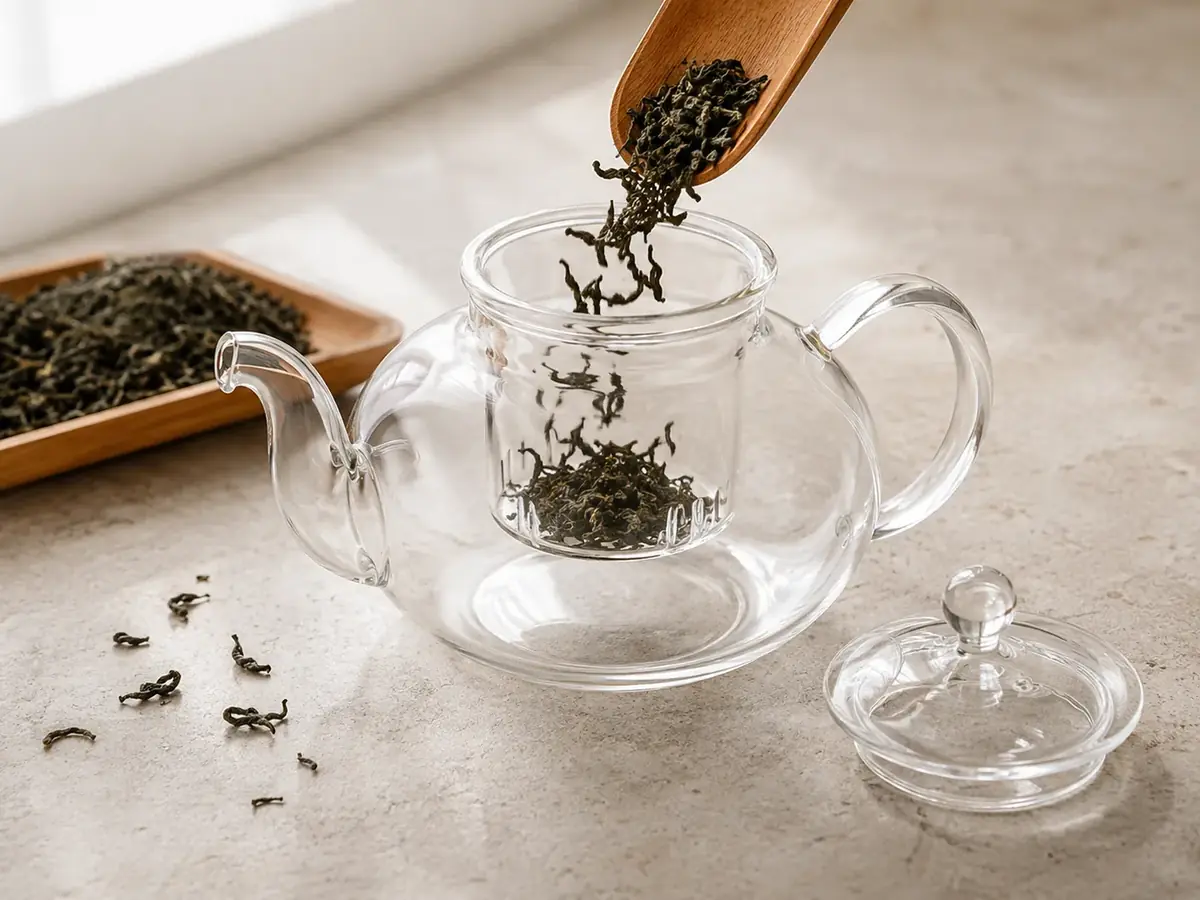
People sometimes ask whether the removable infuser insert is as robust as the body. It is the same borosilicate, and it takes the stream directly, which is where you should be aiming anyway — pouring onto the leaves in the insert spreads the heat through the leaf bed rather than concentrating it on one patch of glass.
The lid is the part that sees the least stress, since it only meets steam. Its ball knob stays cool enough to lift because glass conducts heat poorly, which is the same property that makes the pot itself hold temperature better than most people expect from something transparent.
Boiling water in a glass teapot: the short answer
Yes. Borosilicate is made for boiling water. Pour onto the leaves, do not jump straight from fridge to kettle, and keep abrasives away from it.

Elena Marsh · Founder, Teabrim
Elena set up Teabrim after years of brewing loose leaf in a kitchen that never had the right basket. She writes the Teabrim brewing guides.