
Tea infuser bottle
A travel infuser has a problem no kitchen infuser has: there is nowhere to put the leaves when the tea is ready. This bottle answers it by separating the chambers rather than by making the basket smaller.
projected annual growth for leaf tea in North America through 2031
of American households keep tea in the cupboard
The problem with brewing on the move
Put loose leaf in a flask and by the time you drink it, forty minutes later, it is bitter. The leaves never stopped. Most travel infusers acknowledge this and then fail to fix it: they suspend a small basket in the liquid, which brews continuously, or they expect you to remove a soaking basket on a train and put it somewhere.
The separation design takes a different route. The leaf never has to leave the bottle, and it does not need to, because it is only in contact with the water when you choose.
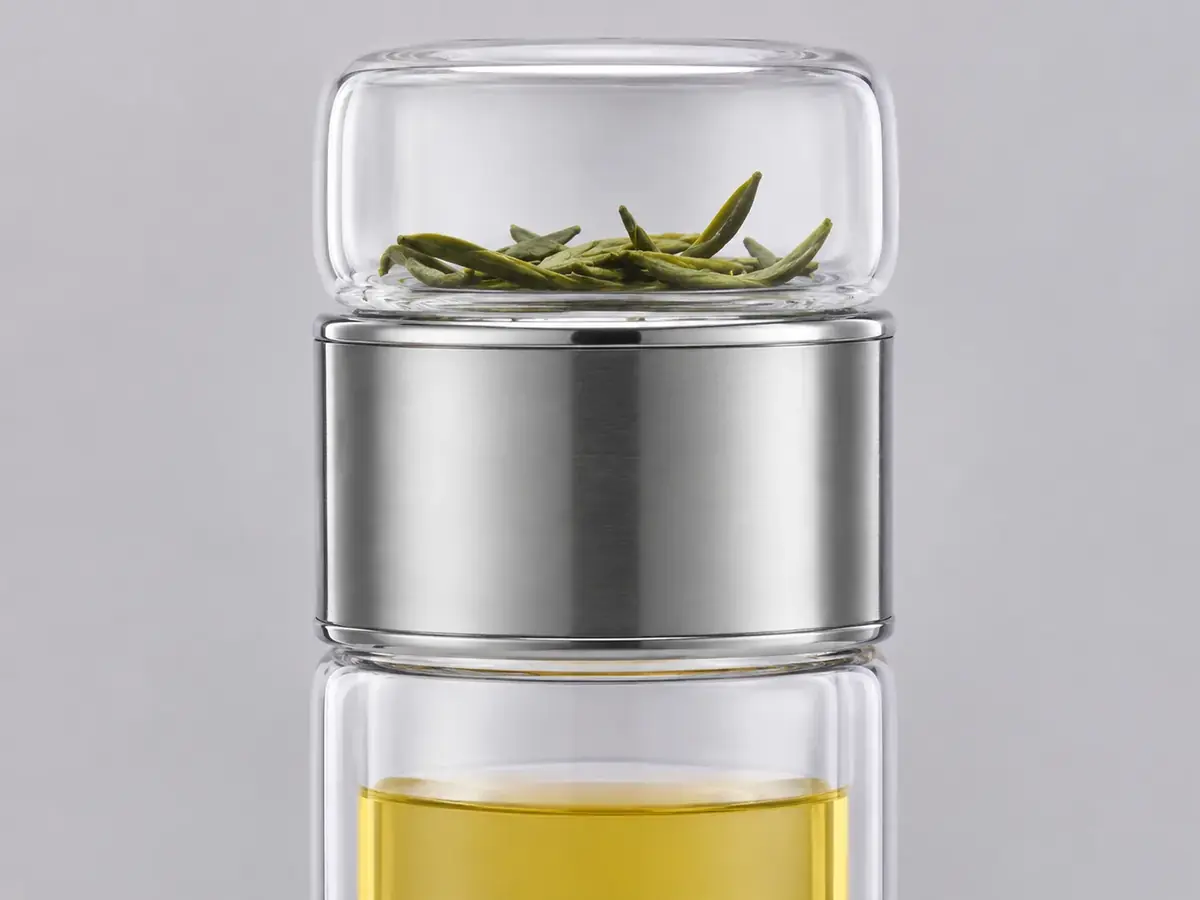
How the tea infuser bottle works
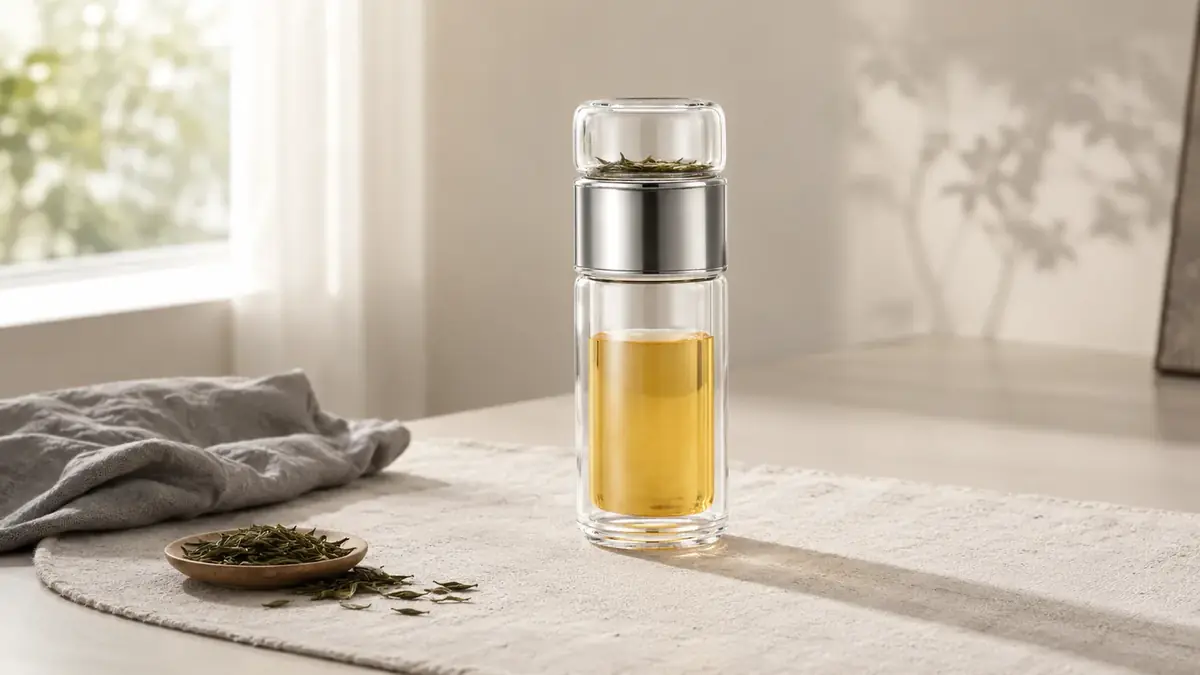
The bottle is one glass tube with a stainless steel collar around its middle. Above the collar is a sealed chamber for the dry leaf, with its own clear screw cap on top. Below it is the drinking chamber, 420 ml.
Fill the lower chamber with hot water, put the leaf in the upper one, close it, and turn the bottle upside down. Water passes into the leaf chamber and brews. When it tastes right — and you can see the color through the glass — turn it upright again. The liquid drains back down through the collar and the leaves stay above it, out of contact. The tea in your hand is finished tea, and it stays that way.
| Step | What you do | What happens |
|---|---|---|
| 1 | Hot water into the lower chamber | 420 ml, about a cup and three quarters |
| 2 | Leaf into the upper chamber, cap on | Sealed above the collar, dry |
| 3 | Invert | Water reaches the leaf and brews |
| 4 | Turn upright when the color is right | Tea drains back, leaves stay above |
One buyer describes it more briefly than we can: leaves go in the top, turn it upside down to let it steep, turn it right side up and it is ready to go.
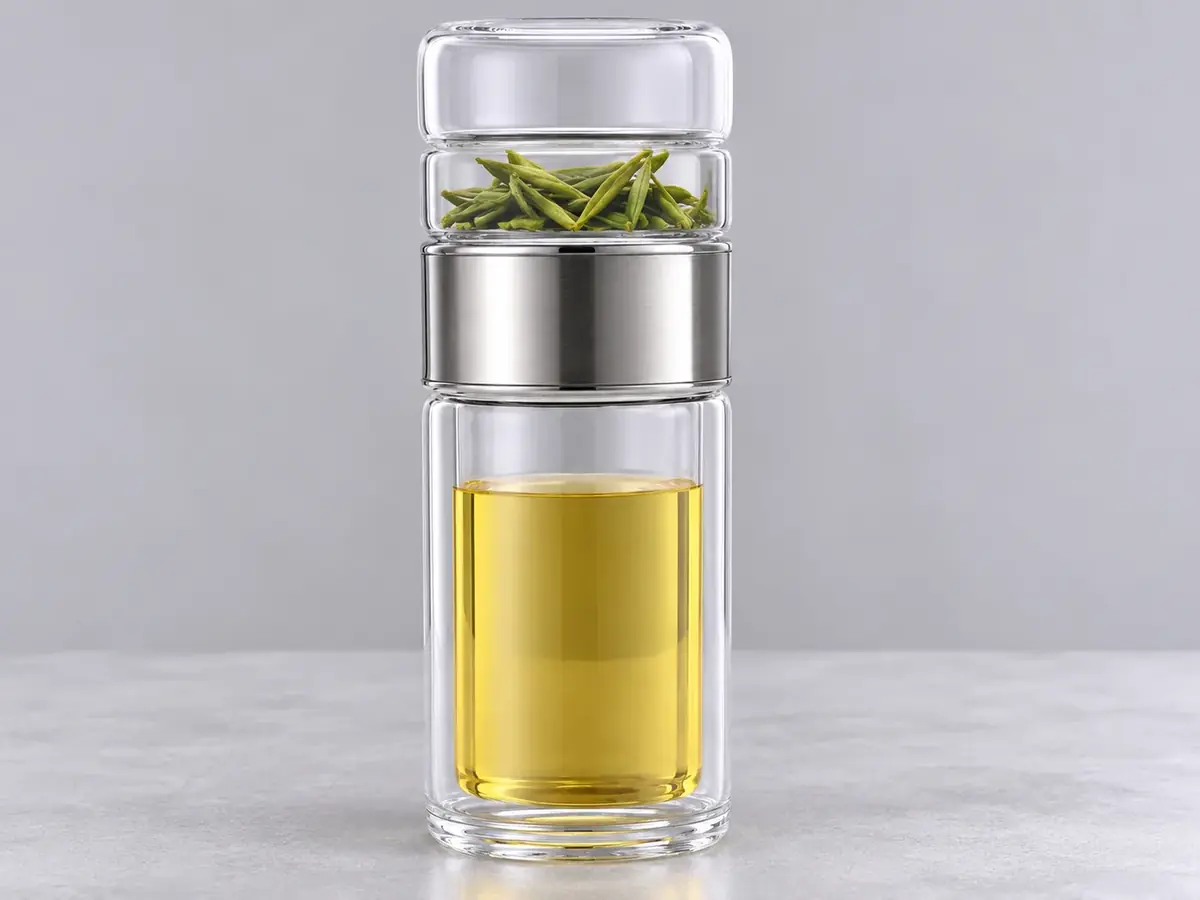
Double wall, and what it is for
The body is two layers of borosilicate glass with a gap between them. That gap does two things. It keeps the outside cool enough to hold when the inside is near boiling, which matters on a bottle you carry. And it slows heat loss, so tea stays warm longer than it would in single-wall glass — though this is not a vacuum flask and will not hold heat for hours. Expect warm rather than hot after an hour.
It also means no condensation on the outside, so it does not leave a wet ring in a bag.
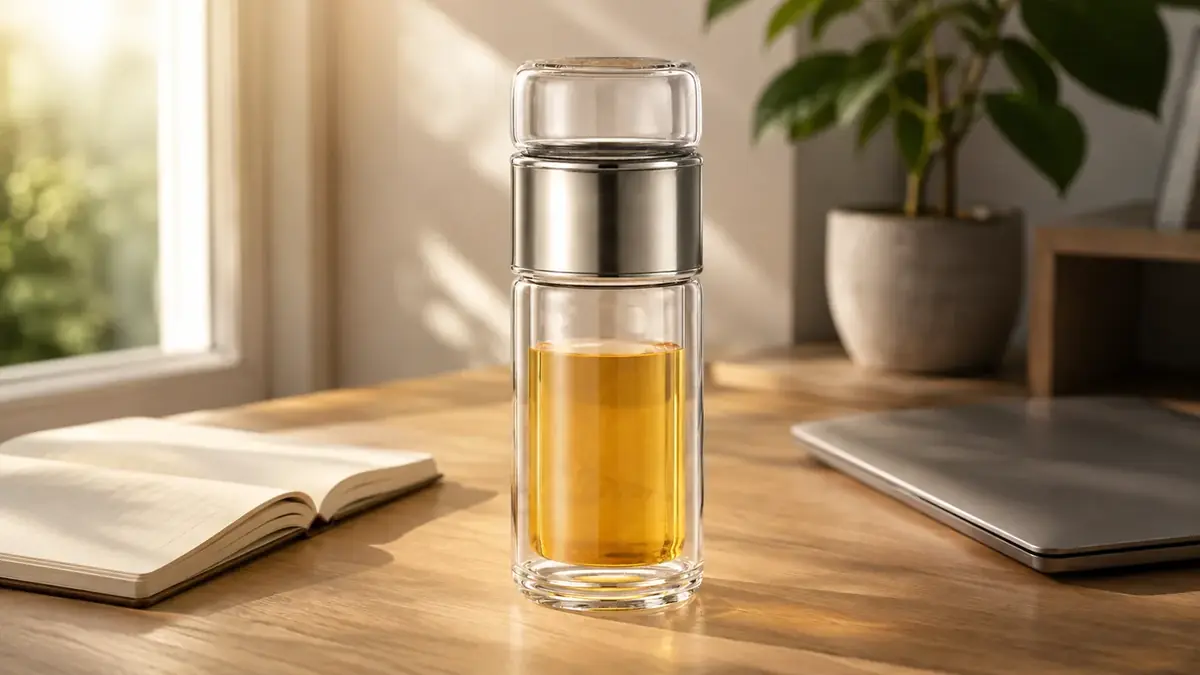
Size, in real terms
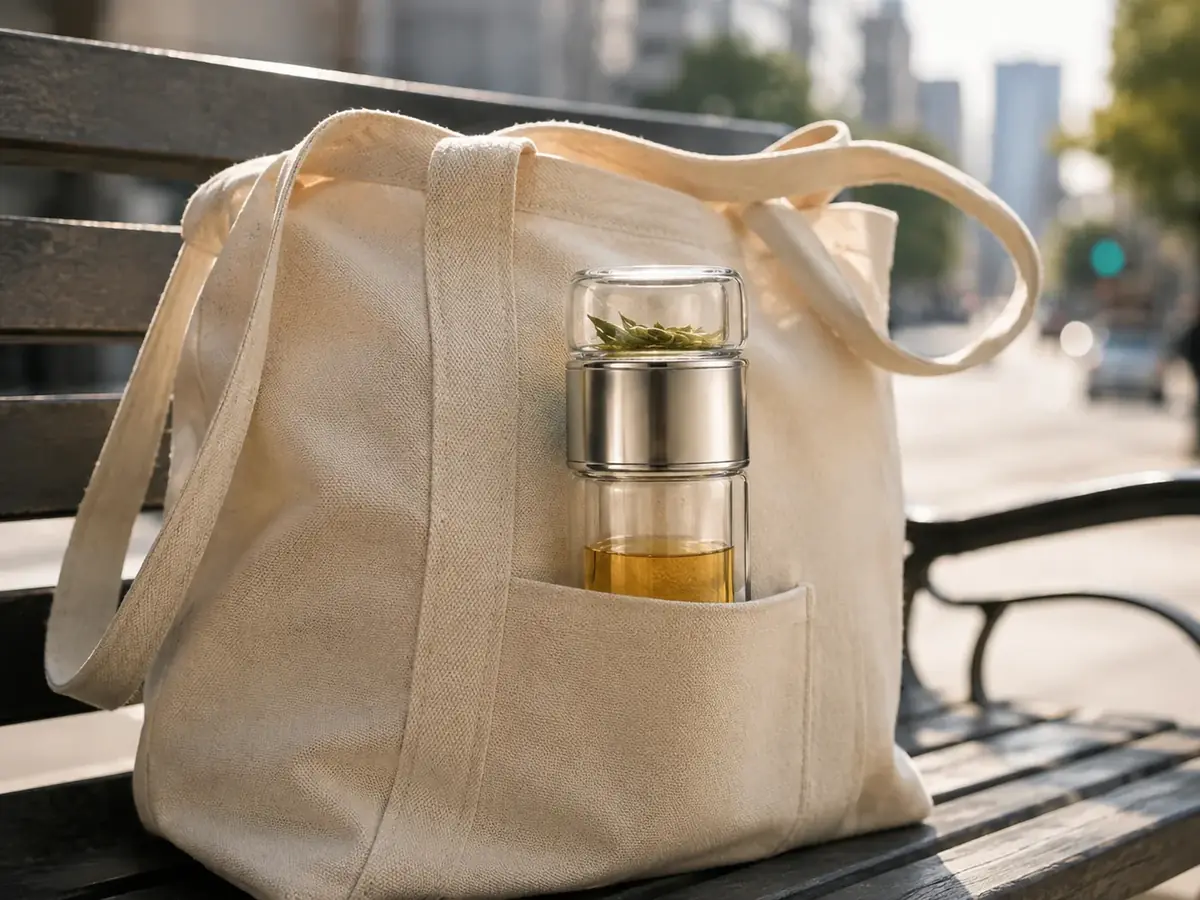
The bottle holds 420 ml and measures 218 mm tall by 70 mm across, which is a standard bottle-cage and cup-holder diameter. The drinking chamber comes to about one and three quarter cups of 8 fl oz — a proper drink, enough for a commute or a morning at a desk.
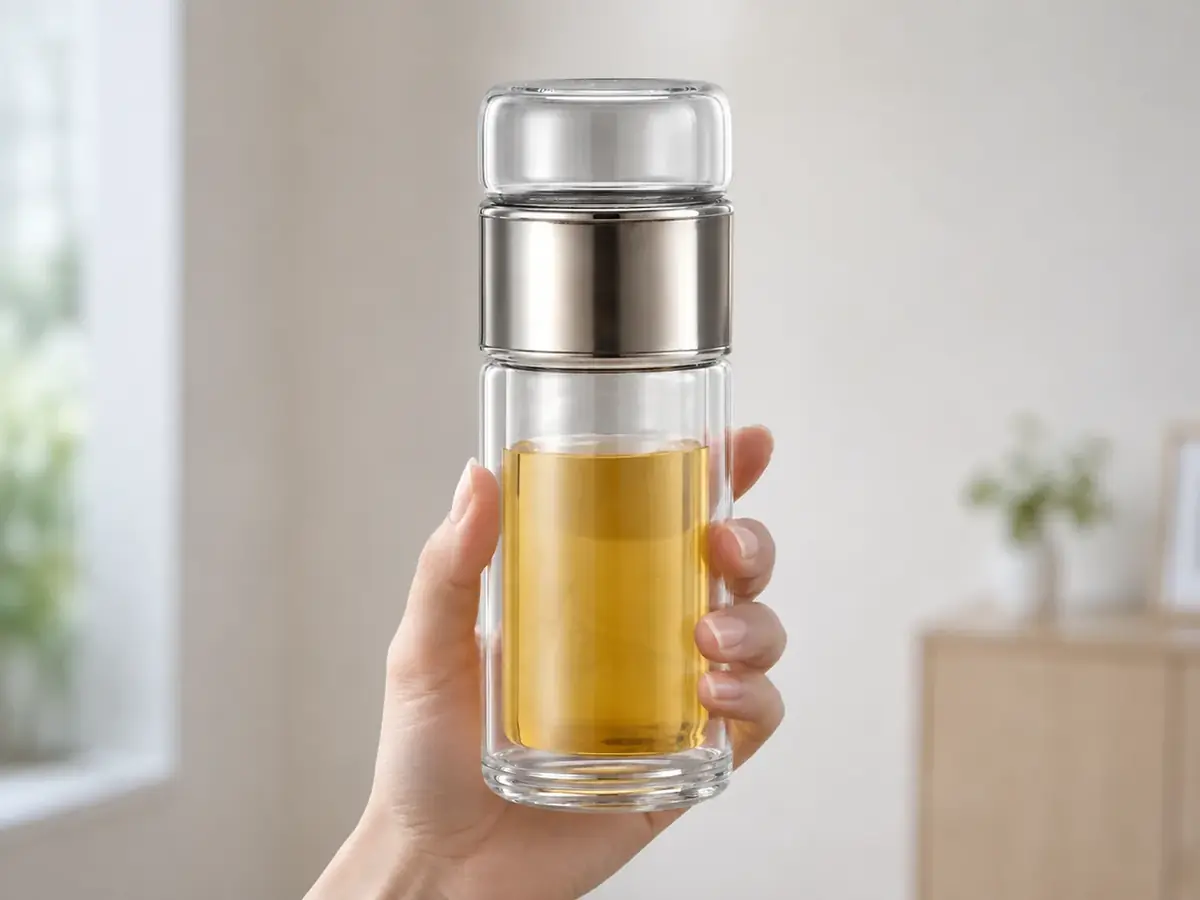
Four collar finishes
The steel collar is the only colored part, and it comes in brushed steel, warm gold, rose gold and deep green. The glass and the cap are the same across all four. Color is the only difference — capacity, mechanism and filtration are identical, so choose on looks alone.
Which format suits which routine
If you want tea at a desk with no carrying involved, the basket on your own mug costs less and washes faster. If you are pouring for other people, the teapot is the format. The bottle earns its place specifically when the tea has to travel with you and still taste like tea when you arrive.
What to brew in the tea infuser bottle, and what to avoid
The separation design suits teas you want to stop precisely: greens, whites and oolongs, all of which turn bitter if left on the leaf. Turn the bottle up at the right moment and the cup stays where you put it, however long the journey takes afterwards.
Rooibos and heavy herbal blends work too, though very fine rooibos will send a little dust through the collar — for those specifically, the steel basket with its finer perforation filters better. Fruit blends with large dried pieces are fine. Powdered tea such as matcha is not: it is meant to be suspended in the water rather than filtered out of it, and any infuser will simply hold it back.
Cold brew, which the tea infuser bottle does well
Fill the lower chamber with cold water, load the leaf, invert, and leave it in the fridge overnight. Cold water extracts far less of the compounds that carry bitterness, so a tea that is unforgiving hot becomes sweet and soft cold. Use about half again as much leaf as you would hot, because the extraction is slower. In the morning, turn it upright and it is ready to leave with you.
Cleaning
Everything unscrews: cap, leaf chamber, collar. Rinse the leaves out of the upper chamber, run water through the collar, and rinse the body. Because the parts separate completely there is no sealed cavity where residue can accumulate out of sight, which is the usual failure of travel infusers with fixed baskets.
Tea infuser bottle questions
How does a tea separation bottle work?
Leaves sit in a sealed chamber above a steel collar, separate from the drink. You invert the bottle so water reaches the leaves and brews, then turn it upright so the tea drains back and the leaves stay above it. Brewing stops when you turn it up, so the tea does not keep getting stronger.
How much does the bottle hold?
The drinking chamber holds 420 ml, roughly one and three quarter cups of 8 fl oz. The bottle measures 218 mm (8.58 in) tall by 70 mm (2.76 in) across, which fits standard cup holders and bottle pockets. The leaf chamber above the collar is separate and does not count towards that volume.
Does the infuser bottle keep tea hot?
The double glass wall slows heat loss and keeps the outside comfortable to hold, but it is not a vacuum flask. Expect tea to be warm rather than hot after an hour. What the double wall does reliably is prevent condensation, so the bottle does not leave a wet patch in a bag.
What colors does it come in?
The steel collar comes in brushed steel, warm gold, rose gold and deep green. Everything else — the glass body, the leaf chamber and the cap — is identical across the four. Capacity, mechanism and filtration do not change with the color, so it is purely an appearance choice.