
· Elena Marsh
Silicone vs stainless steel tea infuser
Both materials are food-safe and both will make you tea. The difference shows up in three specific places, and only one of them is on any product page.
of the North American tea market projected to be loose leaf in 2026
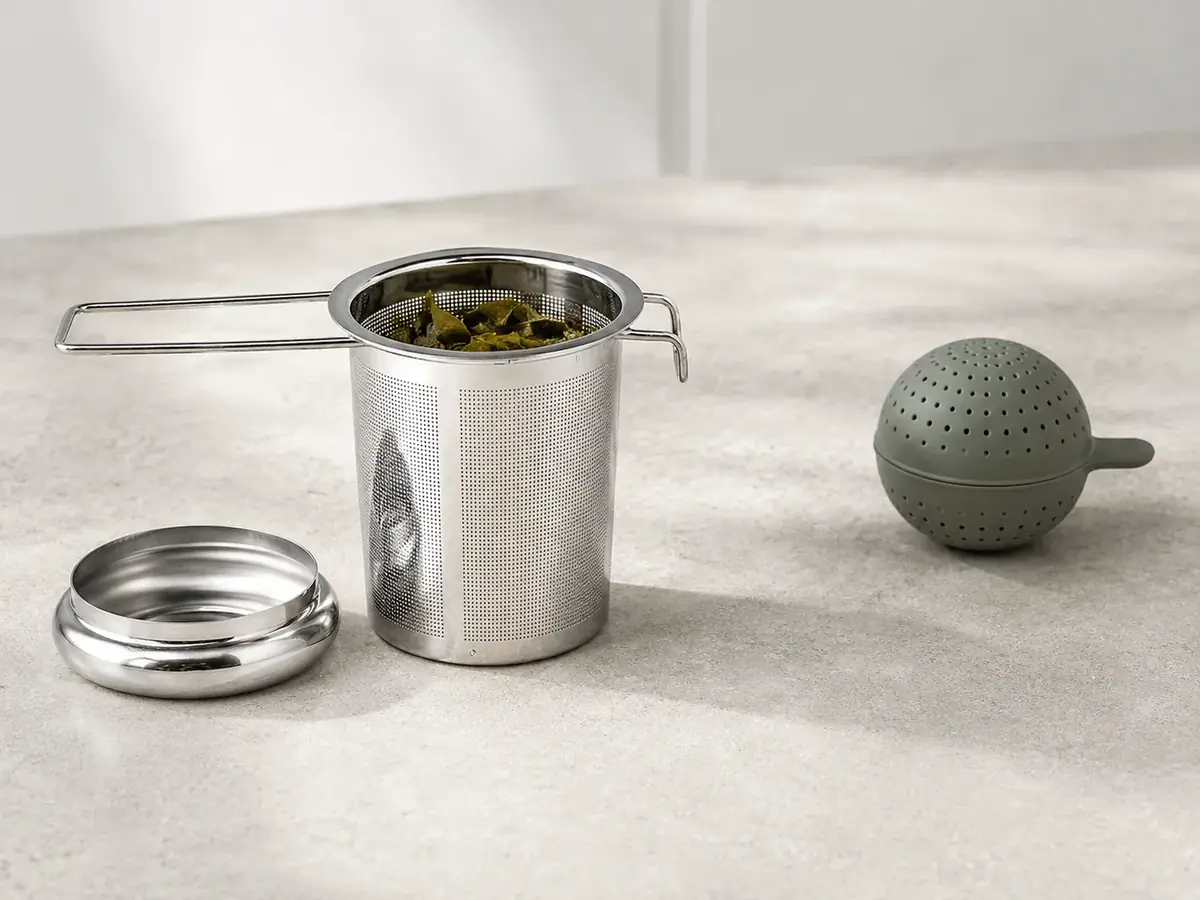
Silicone vs stainless steel tea infuser: where the two genuinely differ
| Stainless steel | Silicone | |
|---|---|---|
| Odor carry-over | None | Absorbs over time |
| Finest hole possible | Very fine perforation | Limited by the mold |
| Water off the boil | Unaffected | Fine, but softens with age |
1. Odor, which is the one people notice first
Silicone is porous at a microscopic level and picks up what it holds. Anyone who has brewed a smoky lapsang souchong in a silicone infuser and then made jasmine green in the same one has met this: the second tea arrives carrying the first. Strongly aromatic herbals do it too.
Steel does not absorb, so the ninth tea tastes like the first. If you drink one tea and only one tea, this never comes up. If you rotate between a black, a green and a herbal blend, it comes up within a fortnight.
2. Hole size, which decides whether bits reach your cup
This is the one that matters most and gets discussed least. A molded silicone hole has a practical minimum: below a certain size the mold will not release cleanly, so silicone infusers have visibly larger openings than perforated steel.
Whole-leaf tea does not care — it passes through nothing either way. What exposes the difference is rooibos, which is almost entirely fine needles, and broken-grade black tea, which carries dust. Both walk through silicone openings and end up in the drink.
So the practical rule is to buy for the finest thing you drink. Our steel basket perforates over the lower two thirds of the wall, fine enough for rooibos.
3. Heat, which matters less than people expect
Food-grade silicone tolerates boiling water without difficulty, so this is rarely a deciding factor on its own. Over years, silicone softens and loses shape; steel does not change. On an object you will own for a decade that is worth something, but it will not be what you notice in the first month.
What steel gives you every day
In a kitchen or on a desk — where the infuser sits in a drawer and meets boiling water daily — fineness and rigidity are the properties that pay off. A perforated steel wall stops broken grades and rooibos that a molded wall lets through, and a rigid basket keeps its shape full of wet leaf instead of collapsing onto it.
If your infuser travels in a bag, that is what the infuser bottle is for: the leaf chamber is sealed, and nothing loose rattles around your things.
Shape matters more than material
Here is the thing both camps miss. Most silicone infusers are small novelty shapes, and most steel infusers are either small balls or wide baskets. The capacity difference between a ball and a basket is larger than the difference between silicone and steel.
Dried leaf can triple in volume as it rehydrates. If it cannot expand, only its outer surface brews, and you get a thin cup regardless of what the infuser is made of. Check capacity first, material second. Our basket page sets out the numbers.
What about plastic?
Plastic infusers are cheaper than both and the least suited to the job: many are not rated for sustained contact with near-boiling water, and thin plastic warps, which turns a snug lid into a loose one. If cost is the constraint, a steel basket is close enough in price that the compromise rarely pays.
Cleaning, which is not the same job
Steel rinses. Tap the leaves out while the basket is warm, run water through it, and a soft brush clears anything stuck in the perforations. Dried tannin is the only thing that marks it over time, and that is a habit rather than a material problem — a soak in warm water with a little citric acid resets it.
Silicone needs more attention, because the same porosity that lets it take on odor also lets residue settle into the surface. Warm soapy water and a periodic soak keep it fresh; a dishwasher cycle helps. Neither is difficult, but they are different routines, and the steel one is shorter.
How long each lasts
A steel basket that is rinsed after use looks the same after years. There is nothing in it to perish: no seal, no hinge, no coating. The two handles keep their spring because the metal does not soften.
Silicone ages more visibly. It gradually loses some flexibility, picks up staining from strongly colored teas, and can hold a faint smell even after cleaning. None of that stops it working, but it is the reason silicone infusers tend to be replaced and steel ones tend not to be.
Price, and what it buys
The two materials sit close enough in price that cost rarely decides it. Where the money actually goes is size and finish: a wide basket with fine perforation and a fitted lid costs more to make than a molded ball, in either material, because there is more of it and the tolerances are tighter.
That is the spend worth making. An infuser is an object you use every day for years and it has no moving parts to wear out, so the difference between a good one and a cheap one is paid once and returned every morning.
One more thing to check before either
Look at how the infuser opens. A basket you tip and rinse takes seconds. A hinged ball with a clasp traps leaf in the seam, and the clasp is the part that eventually fails on a cheap one. Whatever the material, a shape with no hinge and no seal has nothing to go wrong and nothing to clean around.
The short version: silicone vs stainless steel tea infuser
Rotating between several teas, or drinking rooibos and broken-grade blacks? Steel, and a wide one. Carrying tea with you? The bottle, which brews and carries in one object. Either way, check how much leaf it holds before you check what it is made of.

Elena Marsh · Founder, Teabrim
Elena set up Teabrim after years of brewing loose leaf in a kitchen that never had the right basket. She writes the Teabrim brewing guides.