
· Elena Marsh
How to use a tea infuser
The mechanics take thirty seconds to learn. What takes longer is the judgement, and that is mostly about knowing which of three variables to change when a cup comes out wrong.
Americans drinking tea on any given day
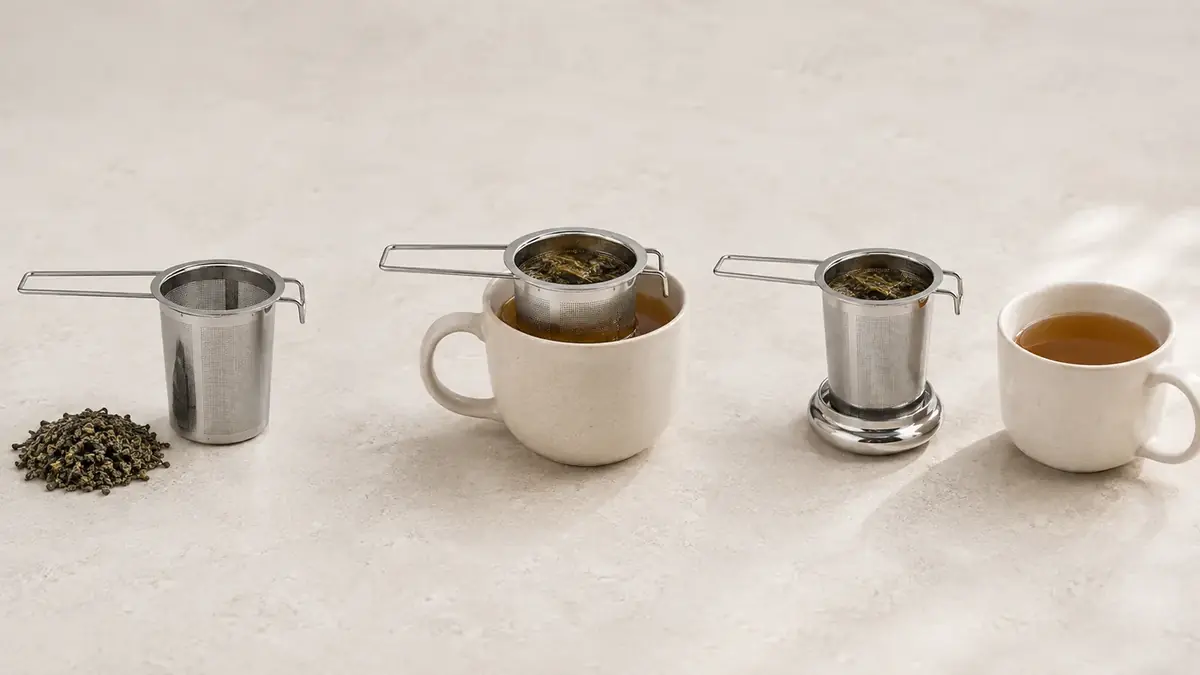
Step by step: how to use a tea infuser
1. Measure the leaf
A level teaspoon per 8 fl oz cup is the standard starting point. Large twisted leaves such as rolled oolong or whole-leaf white weigh far less for their volume, so give those a heaped spoon or one and a half. There is more on this in our guide to how much tea per cup.
2. Hang the basket
It rests on the rim, not in the bottom of the cup. Two unequal handles carry it — a long flat arm and a short hook — which is what lets one basket sit on mugs of different widths.
3. Pour over the leaves, not beside them
Aim the water at the leaf bed. It wets everything at once and starts extraction evenly. Pouring down the side of the mug leaves half the leaf dry for the first thirty seconds.
4. Cover it
A mug has a wide open surface and loses heat fast — several degrees in the first minute. The domed lid holds temperature and aroma in. Skipping this is the most common reason a cup tastes flat.
5. Lift it out
When the tea tastes right, take the basket out and set it upside down on the flipped lid. Extraction stops. This is the single thing an infuser does that a tea bag left in the cup does not.
Water temperature, which matters as much as time
| Tea | Water | Steep |
|---|---|---|
| Green | Off the boil, wait 1–2 min | 2–3 min |
| White | Off the boil, wait 1–2 min | 3–5 min |
| Oolong | Just under boiling | 3–5 min |
| Black | Full boil | 3–5 min |
| Rooibos and herbal | Full boil | 5 min or more |
Green tea in water straight off the boil turns bitter no matter how quickly you pull it, because the heat scalds the leaf and pulls astringency forward. If you change one habit, change this one.
Fixing a cup that came out wrong
Bitter or harsh
Almost always too long, or water too hot for the leaf. Cut thirty seconds first, then drop the temperature. Adding more water to dilute does not remove the bitterness, it just spreads it.
Thin and watery
Usually not enough leaf, or an infuser too small for the leaf to open. If you are using a ball or a clip, this is the likeliest cause — the leaf cannot expand, so only its outer surface ever brews.
Cloudy with bits in it
The mesh is too coarse for what you are brewing. Rooibos and broken-grade black are the two that expose this. See strainers and mesh fineness.
Getting a second cup out of the same leaf
Whole-leaf oolong, white and pu-erh will give a second and often a third infusion, and the second is frequently the best one because the leaf has finally opened all the way. Add about thirty seconds each time.
This only works if the leaf had room to open in the first place, which is why people who use small ball infusers tend to think multiple steeps are a myth. Broken-grade black tea gives most of what it has to the first cup regardless.
What to do while it steeps
Leave it alone. Stirring or pressing the leaf against the mesh forces out astringency that would otherwise have stayed in, which is the same reason squeezing a tea bag makes it harsh. Set a timer if you are doing something else — the commonest way a good cup is ruined is a phone call at minute two.
Cleaning, and the one habit that matters
Tap the spent leaves out while the basket is still warm and they come away in one piece. Rinse under running water; a soft brush clears anything lodged in the perforations. Do it immediately rather than at the end of the day — dried tannin is what eventually stains mesh, and it takes a soak to remove where a rinse would have prevented it.
If a basket has already gone dull, warm water with a little citric acid lifts tannin without scouring. Avoid wire wool: it scratches the polish and gives future residue somewhere to hold.
How to use a tea infuser for a pot rather than a cup
The same basket works held over a cup while you pour a pot through it, because the perforations are finer than a typical strainer weave. If you brew in a pot regularly, a pot with its own full-height glass insert saves the juggling.
Brewing more than one cup from one basket
The basket holds enough leaf for more than a single mug, which is useful when two of you are drinking at once. Brew the first cup to strength, lift the basket out, then hang it on the second mug and add about thirty seconds. With whole-leaf teas the second cup is often the better of the two. With broken-grade black tea it will be noticeably lighter, because those give up most of what they have quickly.
Cold brew, which uses the same basket
Put the basket in a jug of cold water in the fridge and leave it six to twelve hours. Use about half again as much leaf, because cold extraction is slow. What comes out is sweeter and far less astringent than the same tea hot, since the compounds that carry bitterness need heat to release. Lift the basket out in the morning and the jug keeps for a couple of days.
This is the one method where leaving the leaf in overnight is correct rather than a mistake — the extraction is gentle enough that it does not tip into bitterness.
You can follow every step above perfectly and still get a thin cup if the infuser is too small. Dried leaf can triple in volume as it rehydrates, and it needs somewhere to go. That is the entire case for a wide basket over a pinched ball, and it is why the first thing to check when tea disappoints is not your timing but your equipment.

Elena Marsh · Founder, Teabrim
Elena set up Teabrim after years of brewing loose leaf in a kitchen that never had the right basket. She writes the Teabrim brewing guides.