
· Elena Marsh
How much loose leaf tea per cup
Every packet says a teaspoon, and a teaspoon of one tea can weigh three times what a teaspoon of another does. That single fact explains most of the confusion, and once you see it the adjustments become obvious.
of American households keep tea in the cupboard
Why the spoon is a bad unit and everyone uses it anyway
A teaspoon measures volume. Tea is sold and brewed by mass. Those two only line up if every tea has the same density, and they do not come close.
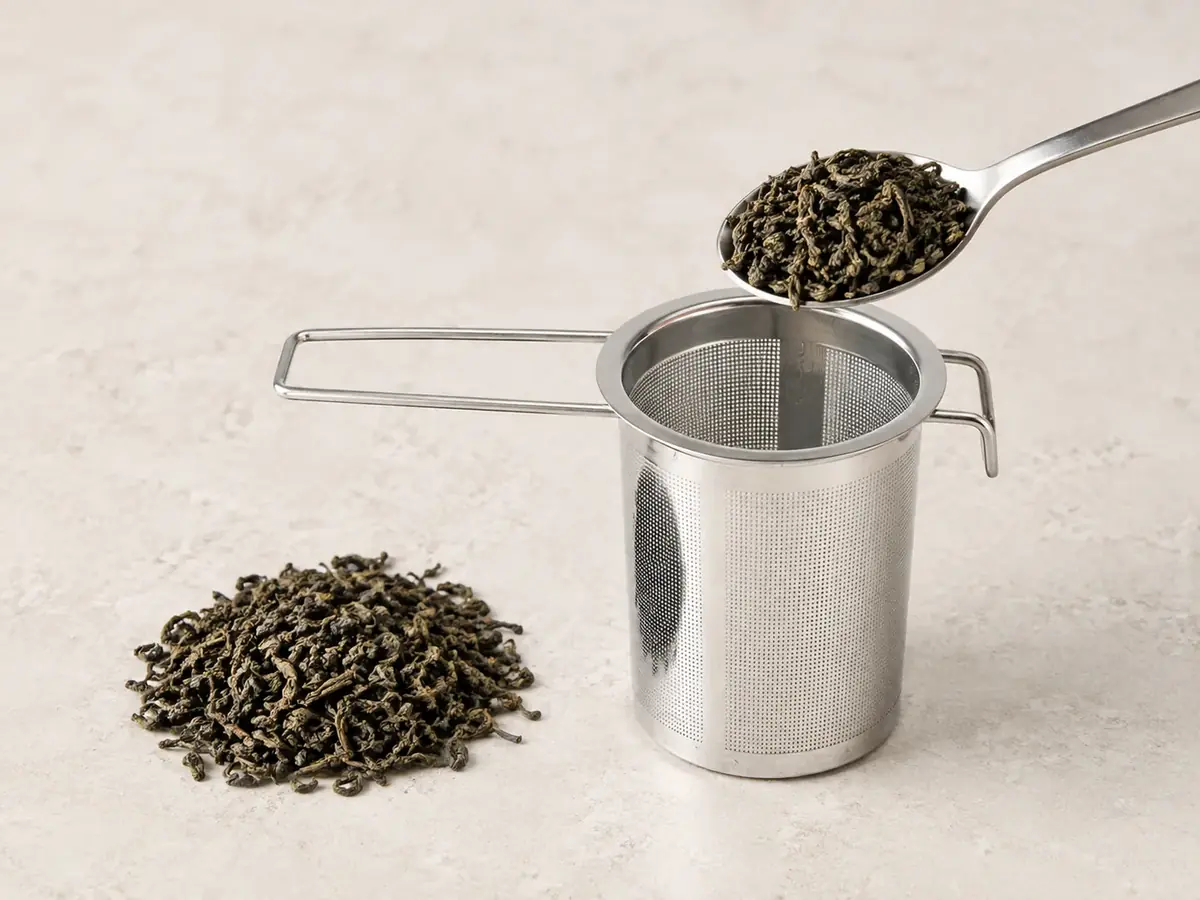
A fine broken-grade black tea is dense: the particles are small and pack tightly, so a level teaspoon might be 3 grams. A rolled oolong is mostly air between large twisted leaves, and the same spoon might hold 1.5 grams. Whole-leaf white is lighter still. Brewing both at one level teaspoon gives you a strong black tea and a thin oolong, and it looks like the oolong was poor when it was simply underdosed.
How much loose leaf tea per cup: the working numbers
| Leaf type | Per 8 fl oz cup | Roughly |
|---|---|---|
| Broken-grade black, fine | Level teaspoon | 2.5–3 g (0.1 oz) |
| Whole-leaf black | Level to heaped teaspoon | 2.5–3 g |
| Green, small leaf | Level teaspoon | 2–2.5 g (0.1 oz) |
| Rolled oolong | Heaped teaspoon or 1.5 spoons | 3–4 g (0.1 oz) |
| Whole-leaf white | Two teaspoons, loosely | 2–3 g |
| Rooibos and herbal | Heaped teaspoon | 3 g |
If you own kitchen scales, weigh once for each tea you drink regularly and then note which spoon that was. After that you never weigh again — you have calibrated the spoon to the tea, which is what the packet was assuming you had already done.
The wet volume is the number that matters
Dry leaf is a compressed version of a leaf. Add water and it opens: a rolled oolong roughly triples in volume, whole-leaf white can do more, broken grades expand least because they were already broken.
This is why dosing and equipment are the same conversation. Put a heaped spoon of oolong in a small ball infuser and the leaf swells until it presses against the shell and against itself. Water stops circulating and channels around a solid plug, so you have used more leaf and extracted less from it. A basket with headroom lets the same dose actually brew.
Scaling how much loose leaf tea per cup up to a pot
Multiply by cups, then take a little off. A 600 ml (20 fl oz) pot is about two and a half 8 fl oz cups, so start at two and a half teaspoons rather than three; a 1000 ml (34 fl oz) pot is about four and a quarter, so start at four. Larger volumes hold heat longer and extract slightly more efficiently, so scaling linearly tends to overshoot.
Our teapots come in those two sizes, with the cup arithmetic on that page.
Adjusting how much loose leaf tea per cup to taste, in the right order
When a cup is not right, change one thing at a time and change them in this order.
- Time first. It is the easiest to control and the most powerful. Thirty seconds either way is a noticeable difference.
- Then temperature. Especially for green and white tea, where water off the boil scalds the leaf.
- Then dose. Only once the first two are settled, because more leaf brewed badly is not better tea.
Steeping times by tea type are in our steeping guide.
Cold brew needs more
Cold water extracts far more slowly, so use about half again as much leaf and leave it six to twelve hours in the fridge. The result is sweeter and much less astringent, because the compounds that carry bitterness need heat to come out. A bottle with a sealed leaf chamber handles this neatly — load it at night, turn it upright in the morning.
Strength is not the same as caffeine
Doubling the leaf makes a stronger-tasting cup and does raise the caffeine, but the two do not track as neatly as people assume. Steeping time affects flavor compounds and caffeine at different rates, and the tea plant variety and processing matter more than either. The practical point is that adjusting your dose is a flavor decision; if caffeine is what you are managing, the tea you choose does more than the spoon does.
A note on tea bags, for comparison
A standard tea bag holds around 2 grams, which is why one bag per cup roughly matches one level teaspoon. That is a useful anchor if you are arriving from bags: the mass is similar, and what changes is the grade and the room. Bagged tea is usually broken small so it extracts fast in a confined space, while whole leaf needs both more room and a little more time.
If your first loose-leaf cups taste weaker than the bags you were used to, dose is rarely the whole story — check whether the leaf actually had space to open. A basket on the mug rim gives it that space in a way a confined infuser cannot.
Two people, one basket
If two of you drink at the same time, do not double the leaf into one mug. Brew the first cup at the normal dose, lift the basket, then hang it on the second mug and give it thirty seconds longer. With whole-leaf teas the second cup is frequently the better one, because the leaf only finishes opening partway through the first steep.
Keeping the measure consistent
Use the same spoon every time. Kitchen teaspoons vary by a surprising margin, and switching between two of them is enough to make the same tea taste different on consecutive days, which then sends you chasing the wrong variable. Keep one spoon in the tea tin and the problem disappears.
Because leaf grade varies enormously and the market keeps moving towards larger, lighter leaf. Leaf tea in North America is projected to grow 5.85 percent a year through 2031 (Mordor Intelligence, North America Tea Market, 2025), and premium whole leaf is the part growing fastest — which means the average spoonful is getting lighter, and the old teaspoon rule underdoses more teas every year.
Start at a level teaspoon, go heaped for anything large and twisted, and let your own taste settle it after that.

Elena Marsh · Founder, Teabrim
Elena set up Teabrim after years of brewing loose leaf in a kitchen that never had the right basket. She writes the Teabrim brewing guides.