
Tea strainers for loose tea
The two words get used interchangeably in shops and search results, and that costs people money, because they buy the wrong shape for the way they brew. This page separates them properly, then works through mesh, fit and cleanup so you can pick once.
of the North American tea market projected to be loose leaf in 2026
in US tea sales over 52 weeks, up 2.6% year on year
Strainer or infuser: the difference that decides which you need
The distinction is about when the tool touches the leaves.
A strainer works after brewing. Leaves go loose into a pot, brew freely with nothing containing them, and the strainer sits over the cup to catch them on the way out. It is the traditional method and it gives the leaf the most room possible — the whole pot. The trade-off is that the leaves keep brewing in whatever is left in the pot, so a second cup is stronger than the first, and there is a wet heap to clear out afterwards.
An infuser works during brewing. The leaves are contained from the start, and you lift them out when the tea tastes right. That gives you a stop button, which is the single most useful thing you can have when you are learning a new tea. The trade-off is that whatever contains the leaves has to be big enough for them to expand, or you are back to the problem of brewing only the outside of the leaf.
Both are solving the same thing — keeping leaf out of your mouth — at different moments. Neither is wrong. What matters is whether you brew loose in a pot or contained in a cup.
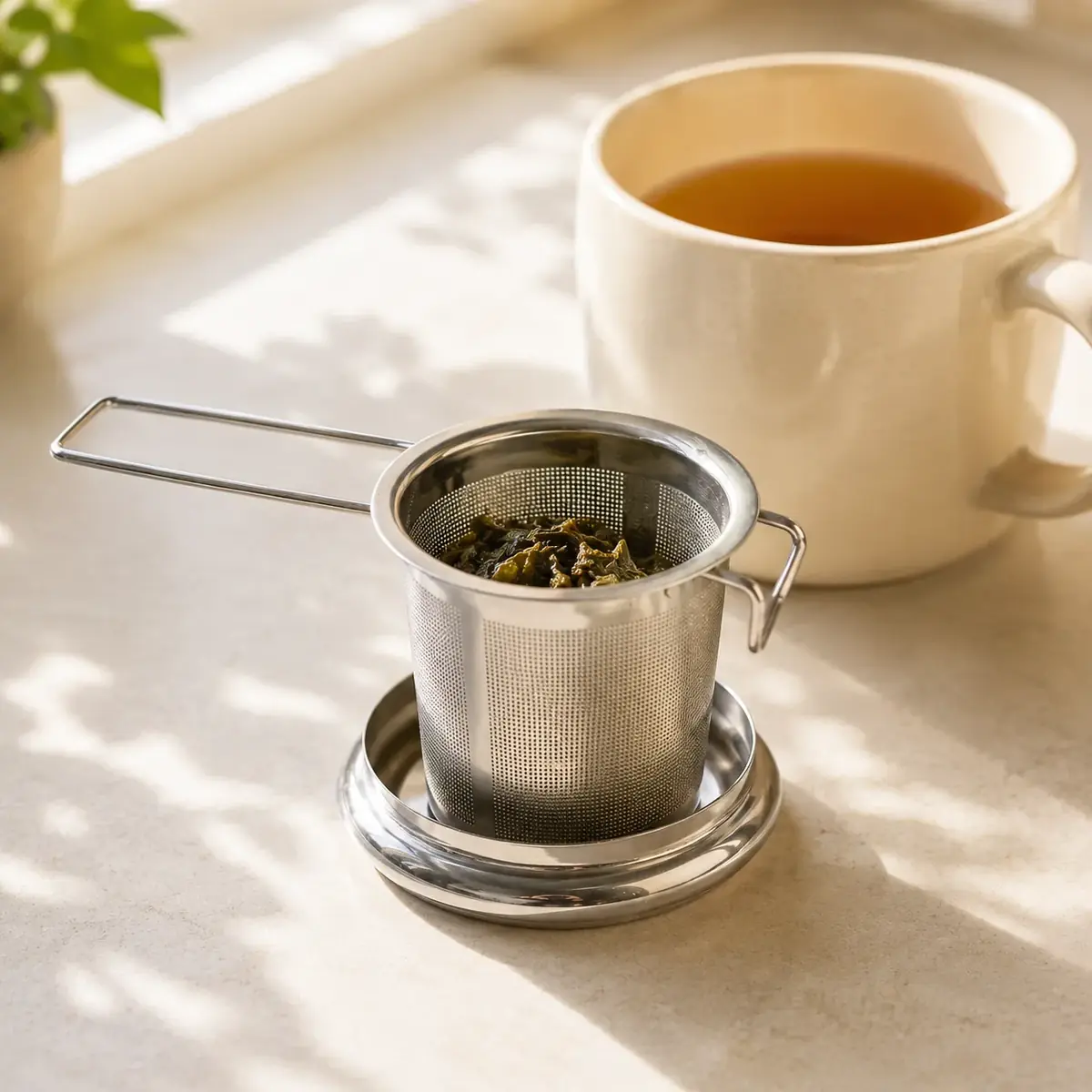
Where our basket sits
The Teabrim basket is an infuser by design: it hangs on the rim of a mug on two asymmetric handles and steeps in the water. But the perforations over its lower two thirds are finer than a typical strainer weave, so it also works held over a cup while you pour a pot through it. That dual use is why the same object turns up under both names.
It is not, to be clear, a classic strainer with a drip bowl and a stand. It is a deep tapered basket. If what you want is specifically a shallow dish on a handle that rests on a saucer, that is a different object and this is not it. If what you want is fine mesh that will hold back rooibos whichever way you use it, this is the shape that does both.
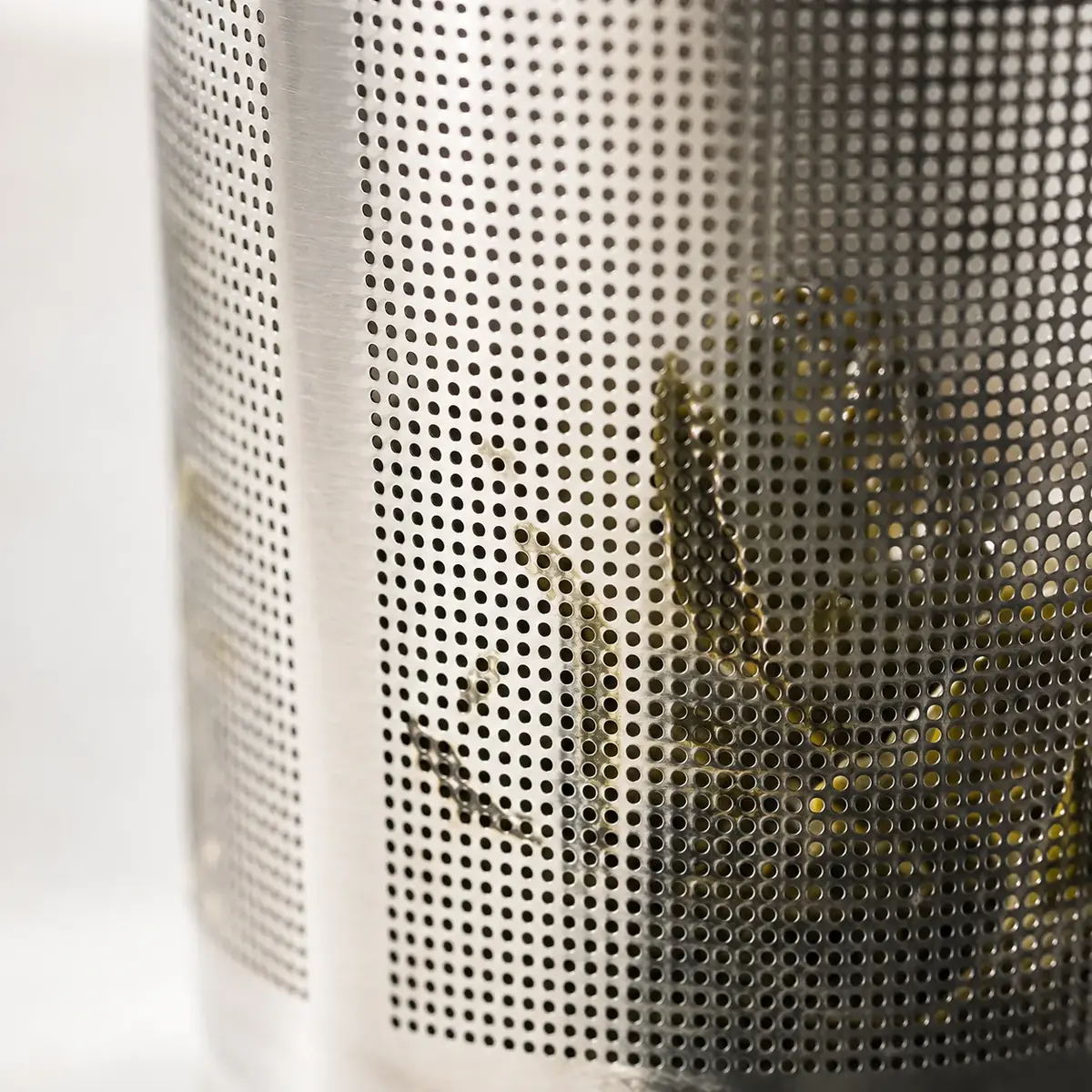
Mesh: the loose tea strainer specification that actually matters
Most disappointment with strainers comes down to hole size, and most product pages never mention it.
Whole-leaf tea is forgiving. A large twisted oolong will not pass through anything. But the teas people drink most in the US are not that: broken-grade black tea carries dust, and rooibos is almost entirely fine needles that behave like sawdust in water. A coarse strainer weave lets both straight through, and you find out at the bottom of the first cup.
| Leaf type | What defeats a coarse mesh | Needs fine perforation |
|---|---|---|
| Whole-leaf oolong, white | Nothing — leaves are large | No, but needs room to expand |
| Broken-grade black | Dust and fannings | Yes |
| Rooibos | Fine needles, almost all of it | Yes |
| Herbal blends | Cut seeds and flower fragments | Yes |
| Matcha and powdered | Everything — do not strain, whisk | Not applicable |
The practical rule: buy for the finest thing you drink, not the coarsest. A mesh that handles rooibos handles everything above it. A mesh that only handles whole leaf fails the moment you try a herbal blend.
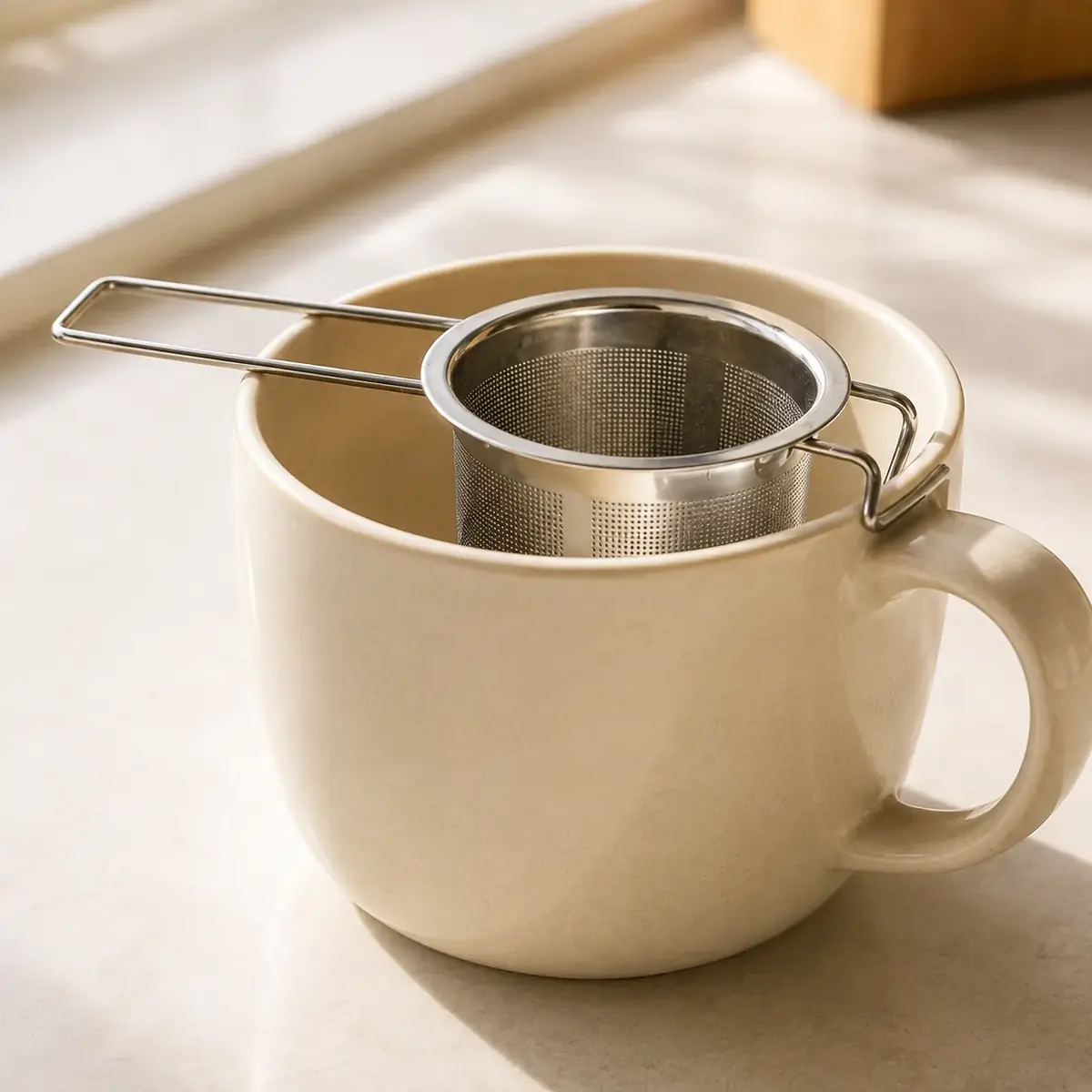
Fit: the second thing nobody checks
A strainer or basket has to sit stably on whatever you own. Ours rests on the rim rather than dropping inside, carried on one long flat arm and one short hook. That asymmetry is the point: the two arms find purchase on rims of different widths instead of needing a cup of a particular diameter. The basket is 6.5 cm (2.56 in) across the top and 7 cm (2.76 in) deep, so any mug with an opening wider than about 7 cm takes it, which covers most standard mugs and teacups.
If you brew in a pot and pour through, the same handles rest across the cup while you pour, leaving both hands free for the pot.
What happens when the tea is ready
This is the unglamorous half of the decision and the one buyers mention most. A wet strainer has to go somewhere. A saucer means another item to wash; the counter means a ring.
The domed lid that covers the mug while the tea steeps turns upside down and becomes a tray with a raised rim, deep enough to hold what drains off. It is a small thing that changes the daily experience of using it, which is why it shows up in buyer feedback far more often than the mesh does.
Steeping, briefly
Contained brewing gives you control, so use it. Green tea two to three minutes, black three to five, oolong three to five, rooibos and herbal five or more, and lift the leaves out rather than leaving them in. Water temperature matters as much as time — green tea in water straight off the boil turns bitter regardless of how quickly you pull it. There is a fuller breakdown in our guide to tea steeping times, and a separate one on how much leaf to use per cup.
Cleaning
Tap the spent leaves out while the basket is still warm and they come away in one piece. Rinse under running water; if a fine grade has lodged in the perforations, a soft brush clears it in seconds. The thing to avoid is letting leaves dry in place — dried tannin is what stains mesh over months, and it takes far more effort to remove than it does to prevent.
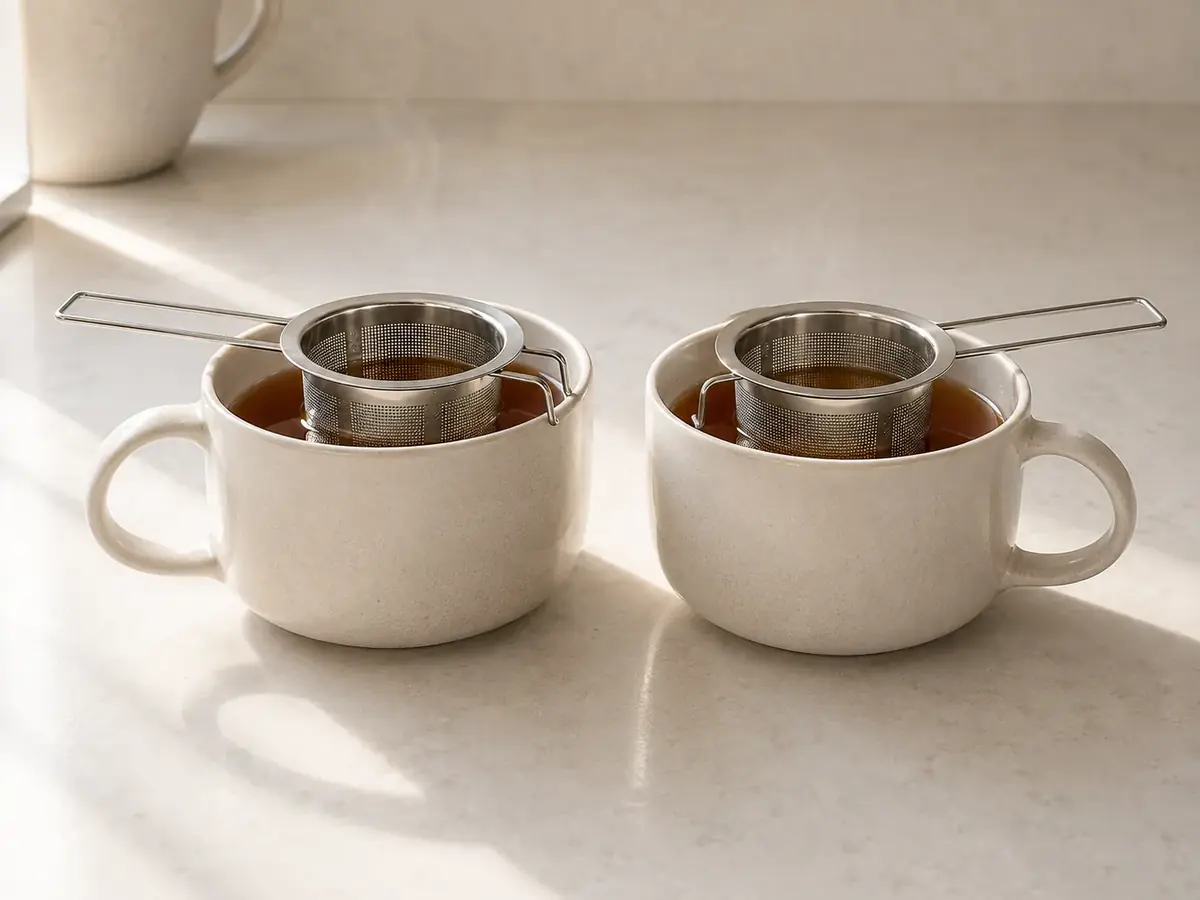
Which one to buy: loose tea strainer or infuser basket
If you brew a cup at a time, take the basket. If you brew a pot for other people, look at the glass teapot with its own full-height insert instead, which contains the leaf without needing a separate strainer at all. If you want tea with you when you leave the house, the infuser bottle keeps the leaves in a sealed chamber above the drink so it stops brewing when you want it to.
All three use the same fine perforation. The choice is about volume and where you drink, not about quality of filtration.
Loose tea strainer questions
What is a tea strainer called?
Strainer, infuser, steeper, tea filter and tea basket all get used for overlapping objects. Strictly, a strainer catches leaves as you pour and an infuser holds them while they brew. Basket and steeper usually mean the infuser type. In shops the words are used loosely, so judge by the shape rather than the label.
Are you supposed to pour the water through the tea strainer?
You pour the brewed tea through it, not the hot water. Leaves brew loose in the pot, then the strainer sits over the cup and catches them as the tea comes out. If you pour water through a strainer full of dry leaf, the contact time is a second or two and you get colored water rather than tea.
What can I use if I do not have a tea strainer?
A fine kitchen sieve works, and so does letting the leaves settle and pouring slowly, though you will get some in the cup. Paper filter bags are the tidiest stopgap. None of these give you the ability to stop the brew at the right moment, which is what a basket infuser adds over an improvised strainer.
What is the best strainer for loose tea?
The one whose mesh is fine enough for the finest tea you drink, and which is deep enough for the leaf to expand. Those two together rule out most small ball infusers and most coarse-weave strainers. A tapered fine-perforated basket covers both, which is why it is the format we sell.