
· Elena Marsh
Tea strainer vs tea infuser
This is the most asked question in the category, and search results answer it badly because shops use the two words interchangeably. The distinction is real, it is simple, and getting it wrong is why people end up with a drawer full of tea gear they do not use.
of the North American tea market projected to be loose leaf in 2026
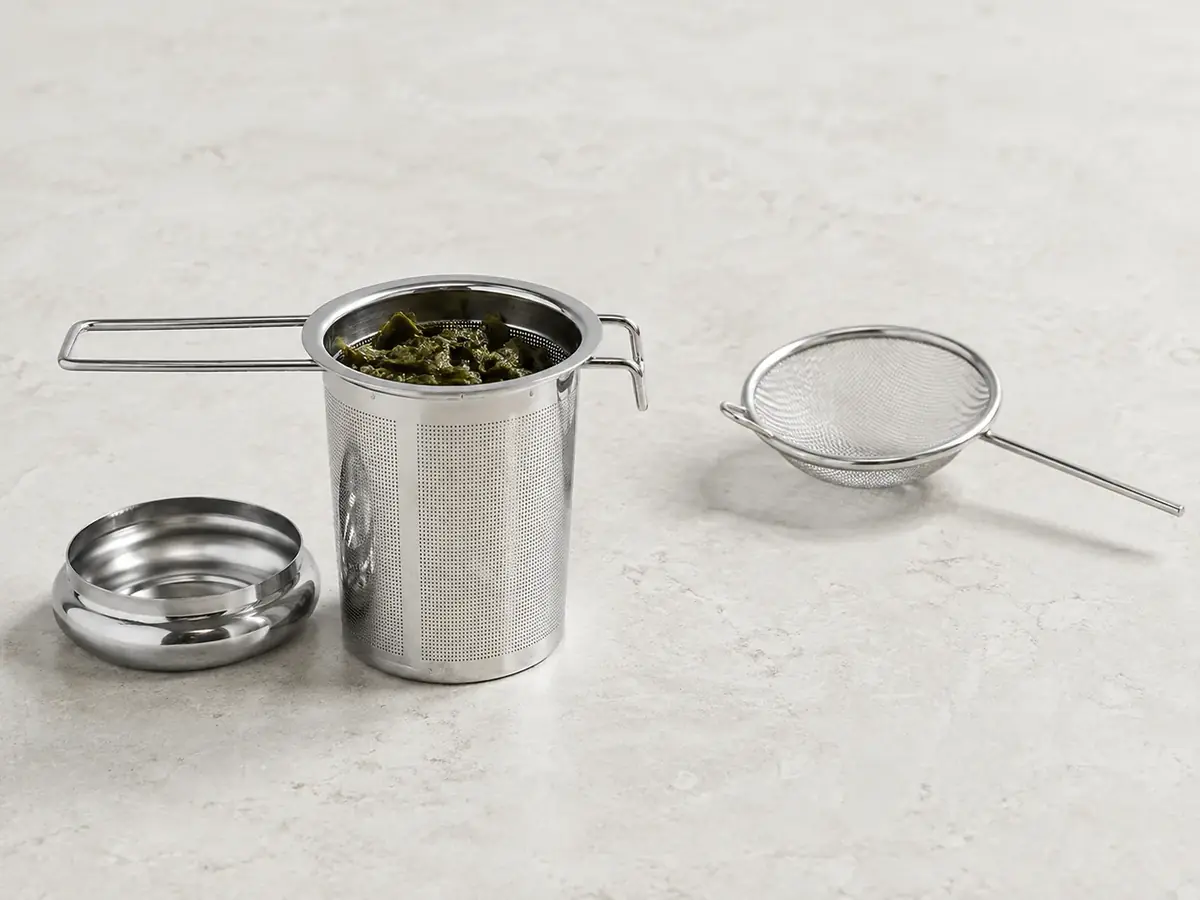
Tea strainer vs tea infuser in one sentence
It comes down to when the tool meets the leaves. An infuser is present during brewing. A strainer arrives after it.
What a strainer does
Leaves go loose into a teapot with nothing containing them. They brew in the full volume of water, which is the most room a leaf can possibly have. When the tea is ready you pour, and a strainer sits over the cup catching the leaves on the way out.
This is the traditional method, and the leaf brews in the full volume of the pot.
What it asks of you in return is that the brewing never stops. Leaves left in the pot keep extracting, so the second cup is stronger than the first and the third is tannic. Serious pot-brewers work around this by decanting the whole pot into a second vessel, which works and adds a step and another thing to wash.
What an infuser does
The leaves are contained from the moment you start. You take the infuser out when the tea tastes right, and extraction stops there.
That stop button is the whole argument for an infuser. It matters most when you are learning a tea, because you can pull it at three minutes, taste, and go four next time. It matters again every day afterwards, because it means the last cup of a pot tastes like the first.
The cost is that whatever contains the leaves has to be big enough for them to expand into. This is where infusers succeed or fail, and it has nothing to do with brand.
The tea strainer vs infuser comparison, laid out
| Strainer | Infuser | |
|---|---|---|
| When it is used | After brewing, while pouring | During brewing, in the water |
| Room for the leaf | The whole pot | Whatever the infuser holds |
| Can you stop the brew? | Only by decanting | Yes — lift it out |
| Suits | Pot brewing, whole leaf | Cup brewing, any grade |
| Washing up | Pot, strainer, and somewhere to drain it | One basket |
Why one object often does both
A deep fine-mesh basket is an infuser by design — it steeps in the cup. But if its perforations are finer than a typical strainer weave, it also works held over a cup while you pour a pot through it. That is why the same object is sold under both names, and why the words blurred in the first place.
Our basket is built that way. The perforations run over the lower two thirds of the wall and hold back rooibos needles, which is the finest thing most people brew.
Where the two genuinely differ
A classic strainer is a shallow dish on a handle, often with a matching drip bowl. It is designed to be held or rested over a cup, never submerged. A basket is deep and tapered and designed to hang in liquid. If what you want is specifically the shallow dish and stand, that is a different object.
Tea strainer vs infuser: which to buy, by how you drink
One cup at a time
Infuser, without hesitation. It hangs on the mug you already own, and the domed lid flips over into a tray for the wet basket. See the mug fit guide for the measurement that matters.
A pot for several people
Either works, but a teapot with a built-in full-height insert gives you both properties at once: the leaf gets a deep bed, and you can still lift it out to stop the brew.
Tea that travels
Neither, in the classic sense. A bottle that separates the leaf chamber from the drink is the format built for it, because there is nowhere on a train to put a wet basket.
Mesh is the specification nobody publishes
Whichever you choose, hole size decides whether you enjoy it. Whole-leaf tea passes through nothing. Broken-grade black carries dust. Rooibos is almost entirely fine needles and walks straight through a coarse weave.
Buy for the finest thing you drink, not the coarsest. A mesh that handles rooibos handles everything above it.
Why “tea strainer vs infuser” gets asked so often
Because tea drinking in the US is mainstream rather than niche, and most people arrive at loose leaf from tea bags with no vocabulary for the equipment. Americans consumed about 86 billion servings of tea in 2023, and over 159 million are drinking tea on any given day (Tea Association of the U.S.A., Tea Fact Sheet, 2024). A large share of that is bagged, and everyone moving across has to learn these two words from scratch.
The good news is that it really is one distinction, and once you have it the rest of the category makes sense.
Two words you will also meet
Steeper is usually a synonym for infuser, sometimes for a mug with a built-in basket and lid sold as a set. Tea filter normally means a disposable paper bag you fill yourself, which gives the leaf room and filters well but has to be opened, filled and thrown away every time.
You will also see tea ball and tea spoon clip, both of which are infusers by function — they hold the leaf during brewing — but hold roughly a teaspoon with no headroom. That capacity is the thing to check before anything else, because a leaf that cannot open cannot brew.
A quick way to decide
Ask two questions of any infuser. First: how much dry leaf does it hold, and is there space left over once that leaf triples? Second: how fine are the holes — would they stop rooibos? Anything that passes both will make good tea whatever it is called on the label, and anything that fails either will disappoint you regardless of price.
Almost everything sold as a strainer passes the second test and fails the first, because it was never meant to contain the leaf. Almost every ball infuser fails the first too. Deep fine-mesh baskets pass both, which is the entire reason the format has taken over.
Brewing in a cup? Infuser. Brewing loose in a pot and pouring? Strainer. Want both properties without owning two things? A deep fine-mesh basket does the job, and it is the reason most people only ever buy one.

Elena Marsh · Founder, Teabrim
Elena set up Teabrim after years of brewing loose leaf in a kitchen that never had the right basket. She writes the Teabrim brewing guides.