
· Elena Marsh
How to make iced tea with loose leaf tea
Most of the tea drunk in this country is cold, and there are two routes to it. One steeps the leaf in cold water overnight. The other brews it hot and chills it in the glass — a different drink, and a different set of decisions. Get the concentration right and the ice does the rest.
of the tea consumed in America is iced
Why iced tea is brewed at double strength
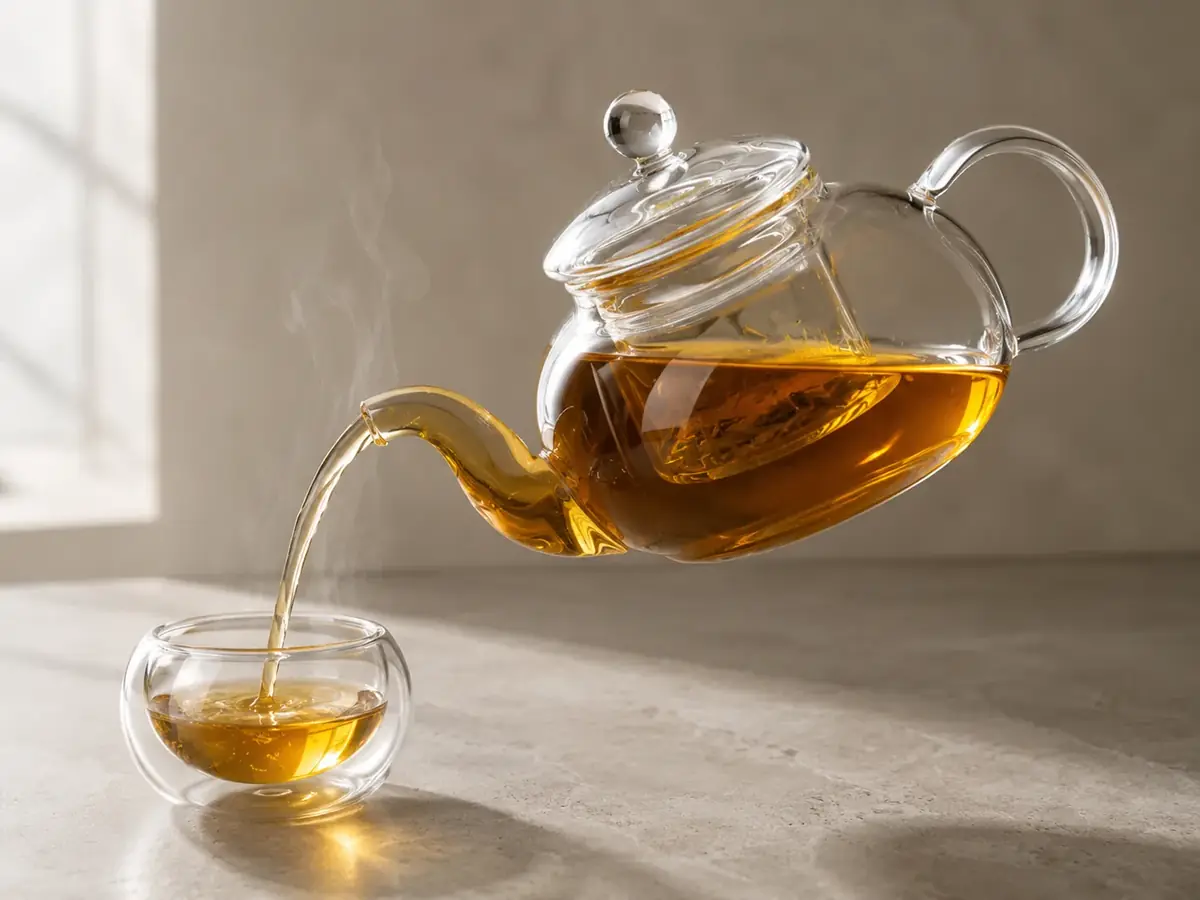
Ice is not a garnish here, it is half the recipe. A glass packed with cubes and topped up with hot tea finishes as a full glass of cold tea, and every drop of that extra volume came out of the ice. Brew at cup strength and the ice turns it pale.
So you keep the leaf and halve the water. Our working dose is a level teaspoon per 8 fl oz cup; for iced tea that same teaspoon goes into 4 fl oz, and the concentrate is poured over enough ice to fill the glass. Only the water has changed, which is why tea made this way tastes like itself. The adjustments by leaf type are the ones in our guide to how much tea per cup — large twisted leaves such as rolled oolong still want a heaped spoon, because they weigh so much less for their volume.
The numbers, by glass size
Read the table by the drink you want to end up with, not by what goes in the kettle. The leaf column is our standard dose, unchanged; only the water has moved.
| Finished drink | Water to brew | Leaf |
|---|---|---|
| 8 fl oz glass | 4 fl oz | 1 level teaspoon |
| 12 fl oz glass | 6 fl oz | 1½ level teaspoons |
| 16 fl oz tumbler | 8 fl oz | 2 level teaspoons |
| 20 fl oz jug (600 ml) | 10 fl oz | 2½ level teaspoons |
| 34 fl oz jug (1000 ml) | 17 fl oz | 4 level teaspoons |
The last two rows take a little off rather than multiplying straight up, for the same reason a pot does: a larger volume holds its heat longer and extracts a shade more efficiently. The ice needs no measuring — fill the glass, pour until full, and the arithmetic has happened.
The clock does not change
This is the part people expect to be different, and it is not. Green still wants its short steep off the boil, black the full boil for three to five minutes, herbal the longest run of all: the table in our steeping guide applies as written, because the leaf does not know what happens to the liquid afterwards.
What changes is your margin. An over-steeped cup cannot be rescued by adding water: you have made tea with the wrong things in it, and thinning it spreads them out without removing them. Here that costs more than usual, because dilution is built into the method and you have already spent it on the ice. Lifting the leaf out on time is the whole technique, which is the argument for brewing in something you can pull the leaf out of.
How to make iced tea: pour it hot, onto ice that is already in the glass
The order matters more here than it does for a hot cup.
- Fill the glass with ice first. Packed to the top, not three cubes rattling in the bottom.
- Lift the infuser out the moment the time is up, before you pour anything.
- Pour the concentrate straight onto the ice while it is still hot.
- Stir once and top the glass back up with ice if the first lot has gone.
Tea left to cool on the worktop spends that time in the range where the next section happens. Poured straight onto ice, it crosses that range in seconds.
The haze that shows up as it chills
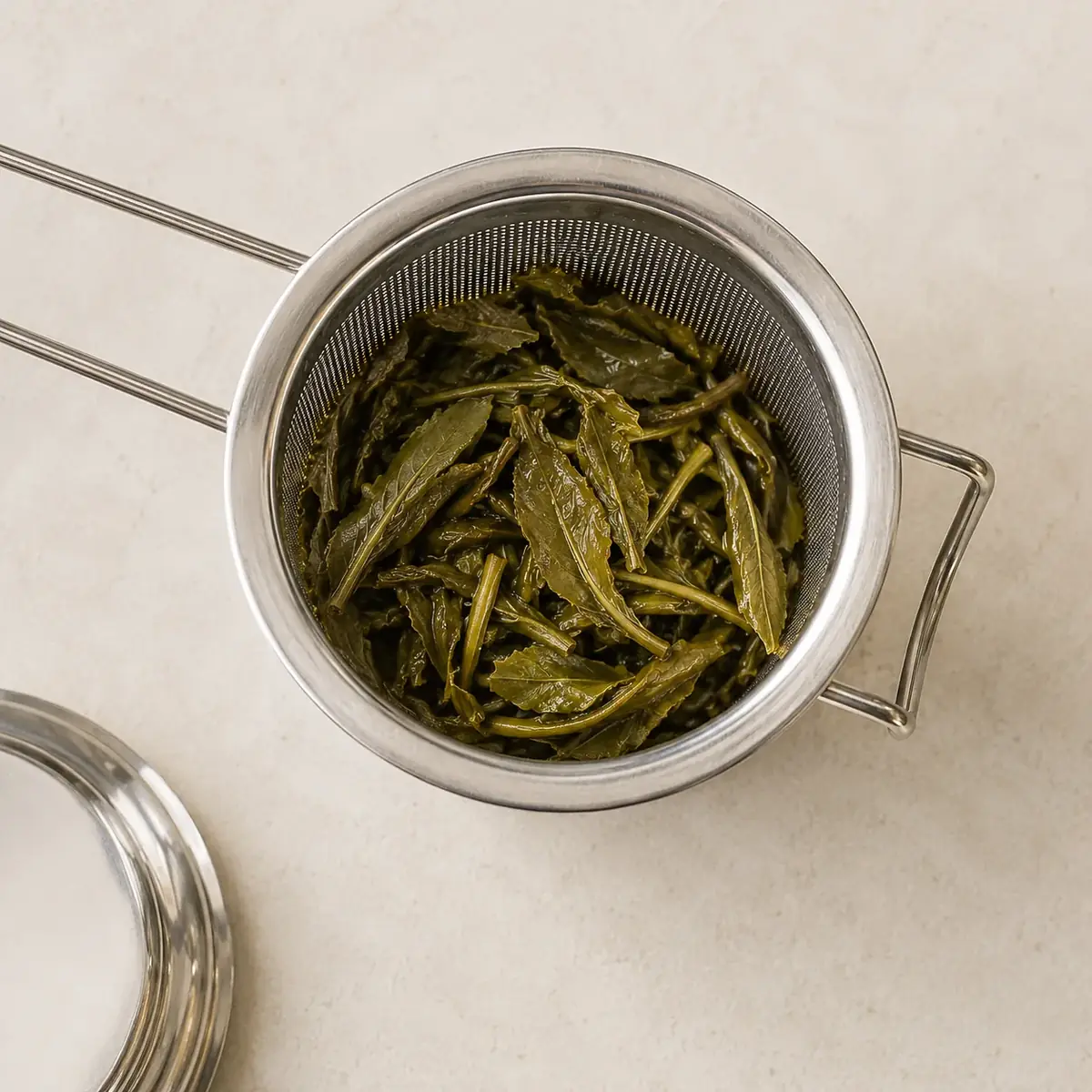
Tea that was clear in the pot often turns cloudy once it is cold, and people read that as dirt, hard water or a poor leaf. It is the tea itself coming back out of solution: as the temperature drops, the interactions between the dissolved components strengthen until polyphenols, caffeine, proteins and polysaccharides combine into the suspension known as tea cream (Foods, 2023, 12(16):2987). Strong black tea shows it most: there is more in solution to combine.
Two habits make it less likely. Pouring hot onto ice carries the brew through the cooling range fast instead of letting it linger, and brewing at the near end of the time range leaves less in solution to precipitate at all.
Haze is a different thing from sediment you can see moving. Loose fragments in the bottom of the glass are a question of hole size, not chemistry, and mesh is the specification that settles it — see our comparison of silicone and stainless steel.
Iced tea and cold brew are not the same drink
Both finish cold, and that is where the resemblance ends. Cold brew never meets heat: most of what carries bitterness stays behind in the leaf, so it comes out soft and sweet, and it takes a night to arrive. Hot-brewed iced tea extracts the lot and then chills it, keeping the aromatic top notes and the briskness that only heat pulls out, ready in the time it takes ice to melt.
The cold method is already set out on this site with its dose and its window — see cold brew in the same basket. Choose by when you want to drink it: tonight, or tomorrow morning.
Which infuser suits which container
A wide basket is the simplest version, and the taper earns its keep here more than anywhere: a doubled concentration packs the same dry leaf into half the water, so it is tighter as it swells and it still has to open all the way. A basket with headroom lets it; a pinched ball turns it into a plug the water goes around.
On a mug the same basket makes a single glass with nothing extra to wash: brew, lift, pour over ice. The rim measurement on the mug format page decides whether it hangs where you want.
A glass teapot is the jug maker, and the useful part is that its capacity is the concentrate, not the finished drink: a 600 ml pot brewed nearly full fills a jug about twice that size once the ice is in. You also get to watch the colour, which is how you stop guessing at the clock.
A bottle with a sealed leaf chamber is the one that travels: brew the concentrate, turn it upright when the time is up so the leaf sits above the drink, and pour over ice at the other end.
A jug: how to make iced tea for several people
For a table of four, brew the concentrate once at the jug quantity rather than making four glasses in sequence. Fill the jug with ice, pour the whole brew in at once, and let it stand a minute. Poured over ice in stages, the first glass comes out strong and the last one watery.
The short version of how to make iced tea
Same leaf, same clock, half the water, ice in the glass before the tea. The rest follows: the concentrate is strong because the ice will dilute it, it comes off the leaf on time because you cannot thin it afterwards, and it hits the ice hot so it never goes hazy on the worktop. Give the leaf room to open and the rest is pouring.

Elena Marsh · Founder, Teabrim
Elena set up Teabrim after years of brewing loose leaf in a kitchen that never had the right basket. She writes the Teabrim brewing guides.